
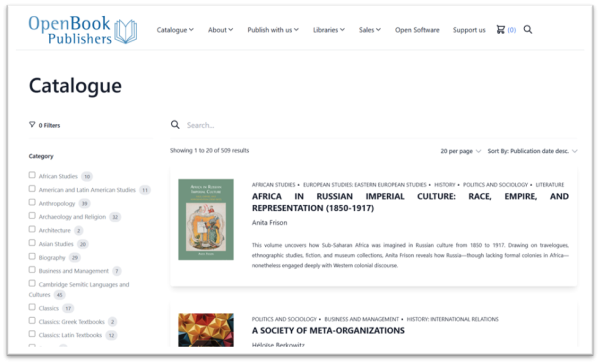
It may surprise some that there is more than one academic book publisher in Cambridge. Open Book Publishing, founded in 2008 by Cambridge academics Rupert Gatti and Alessandro Tosi, is one of the most successful open-access publishers in the UK. In many ways they are redefining how scholarly works in the humanities and social sciences are produced, shared, and accessed—especially in fields often overlooked by mainstream publishers.
In creating a sustainable publishing model for Open Access, OBP have helped foster a more inclusive academic landscape. In an interview for the ATG Podcast, the co-founders explain why they founded their own publishing company and how it operates.
The Challenge of Publishing in Humanities and Social Sciences
For decades, scholarly publishing in the humanities and social sciences has faced significant barriers—high costs, limited accessibility, and a focus on prestige over public impact. Alessandra recalls how her early book on Russian literature was accessible only to a few, especially for readers in Russia itself. This experience sparked a realization that research locked behind paywalls restricts knowledge dissemination, undermining the very purpose of academic work.
Why books matter in the humanities
Unlike articles, which often focus on narrow findings, books provide comprehensive exploration, contextual depth, and a foundation for ongoing scholarship. Yet in fields like social sciences and humanities, access to these vital resources remains limited by financial barriers. The obstacles will be familiar to many in academia:
- High costs of print and digital editions
- Heavy reliance on subscription models that restrict readership
- Disproportionate funding for science versus humanities research.
Without public engagement, research impact stays confined within institutional walls. Benefits of a digital publishing operation include:
- Books can be published online without the hefty printing costs, but without compromising quality – all the titles are fully peer-reviewed.
- Multimedia elements—audio, video, annotations—can be embedded, enriching the reader’s experience.
- Distribution can be global and immediate, far exceeding traditional print reach
- Broader engagement, far beyond academia. The most successful OBP publications have seen hundreds of thousands of views for titles like Ethics for A-Level, and thousands of downloads of Oral Literature in Africa, many from Africa and the developing world.
How Diamond OA can be made to work
OBP uses the Diamond Open Access model, in which neither readers nor authors pay fees. Rupert explained OBP’s ‘mixed revenue’ approach:
- A library programme, comprising donations from approximately 270 libraries worldwide to support the publishing programme
- Where available, grants and research funding to offset costs for authors, but no author is rejected due to lack of funding. The core of OBP’s model is that it is a non-profit enterprise that reinvests all income.
The Role of Infrastructure and Collaboration
OBP is not simply a publisher. In 2022, OBP launched Thoth, an open infrastructure providing metadata management and dissemination platforms that enable small publishers to operate effectively. This infrastructure:
- Automates metadata sharing across hundreds of distribution channels
- Handles diverse formats and platforms
- Supports a collaborative ecosystem, where publishers and libraries work together to sustain open Open Access.
Alliances like the Open Book Collective help scale models such as Thoth, ensuring that small publishers and community initiatives thrive in a competitive landscape dominated by large global firms. Rupert stresses that the goal isn’t competition but collaboration: “The tide rises all boats”.
Measuring Impact and Engagement
Open Access cannot use traditional metrics such as sales figures; not only are titles not sold, they are accessed across several different platforms, not only at the publisher’s site. It is a complex task to gauge readership—downloads, views, and engagement are difficult to count comprehensively because the works circulate freely. Nonetheless, tools such as Thoth provide a way of calculating overall usage of each title, as well as demonstrating there is significant take-up by the public.
The Future of OA
Rupert and Alessandra believe that their model has proven sustainable over nearly two decades. By reinvesting revenue and leveraging partnerships, OBP serves as a proof of concept that open access publishing can thrive without compromising quality or accessibility. However, they acknowledge ongoing challenges:
- The high costs and questionable sustainability of book processing charges in humanities
- The need for robust infrastructure to support small publishers
- The importance of libraries and public funders supporting community-led initiatives over commercial giants.
Embracing a more inclusive Scholarly Ecosystem
Open Book Publishing’s innovative, community-driven, operation demonstrates how Diamond OA can be made to work, and can transform the landscape of humanities and social sciences. It shows how it is possible to prioritize scholarship and accessibility over profit—an idea rooted in the traditional values of university presses, but adapted to the digital age. It’s an inspiring story for researchers, librarians—and for more mainstream publishers.
Leave a Reply