Some implications of "digital" for scholarly writing and communication

Category: publishing

Interview with Allison Belan, Duke University Press

Reading Time: 3 minutes

How can a university press survive and flourish when faced with constant technical change and increasingly monolithic commercial competition? In this interview, Allison Belan, Director for Strategic Innovation and Services at Duke University Press, describes her 20+ years with Duke, and …

The timeline

Reading Time: 3 minutes
A (not very effective) timeline (Cezanne, Pioneer of Modernism, 1995)

Timelines are so ubiquitous, we take for granted how they work, and we assume they have always been around. Clearly, there is a need for a historical perspective, as …

The Library Partnership Rating: a new way to evaluate academic publishers?

Reading Time: 2 minutes

Libraries and publishers interact all the time, but how can a library communicate its vision for scholarly publishing? We all know about the limitations of current metrics for journal publishing: all too often the much criticised journal impact factor is used, …

A Cambridge publishing success story

Reading Time: 3 minutes

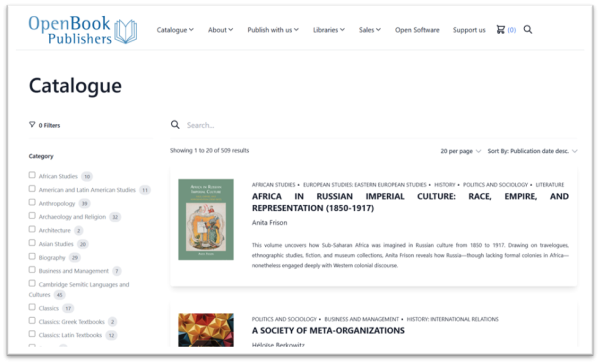
It may surprise some that there is more than one academic book publisher in Cambridge. Open Book Publishing, founded in 2008 by Cambridge academics Rupert Gatti and Alessandro Tosi, is one of the most successful open-access publishers in the UK. …

More about the Failure of the Book

Reading Time: 3 minutes
The Biblia Pauperum, the “Bible of the Poor”, printed in the lower Rhine region or Low countries, c1460. An example of whole-page illustration, where the image, a woodcut, replaces the text entirely. Within a few years, integrated text and illustrations
…

Will Octopus transform scholarly communication?

Reading Time: 4 minutes
Photo by K. Mitch Hodge on Unsplash

Octopus is a new platform for scholarly research: somewhat like a preprint server, with instant publication, but Instead of a full article, a researcher posts just a component of an article: a problem statement, …

Who reads scholarly book reviews?

Reading Time: 4 minutes
The TLS: around 35 book reviews every week

It is a commonplace that nobody reads any more – the Web has put a stop to all that. I googled “Has the Internet destroyed reading?” and got 378 million hits, including (among …

Why are the Oxford Very Short Introductions so successful?

Reading Time: 5 minutes

What makes the Oxford Very Short Introductions series such a stunning success? With over eight million copies sold, they have been honoured by articles in the mainstream media: Kathryn Schulz in the New Yorker devoted a not-so-short article in 2017 to …

Can online conferences improve on their live equvalents?

Reading Time: 2 minutes
The STM Frankfurt Conference 2019. In case you’ve forgotten what real (non-virtual) conferences were like: small screens, big heads in front of you.

Simon Inger, in an interesting post on Scholarly Kitchen (July 7, 2020), makes a tantalising suggestion: an online …

Serendipity as a rule for life

Reading Time: 3 minutes
The spectacular foyer of Waterstones Bookshop, Cambridge. Each book on the wall has a handwritten recommendation.

Many years ago, at the start of my career in publishing, an old hand told me what, in his opinion, was the only marketing principle …

Powered by WordPress & Theme by Anders Norén